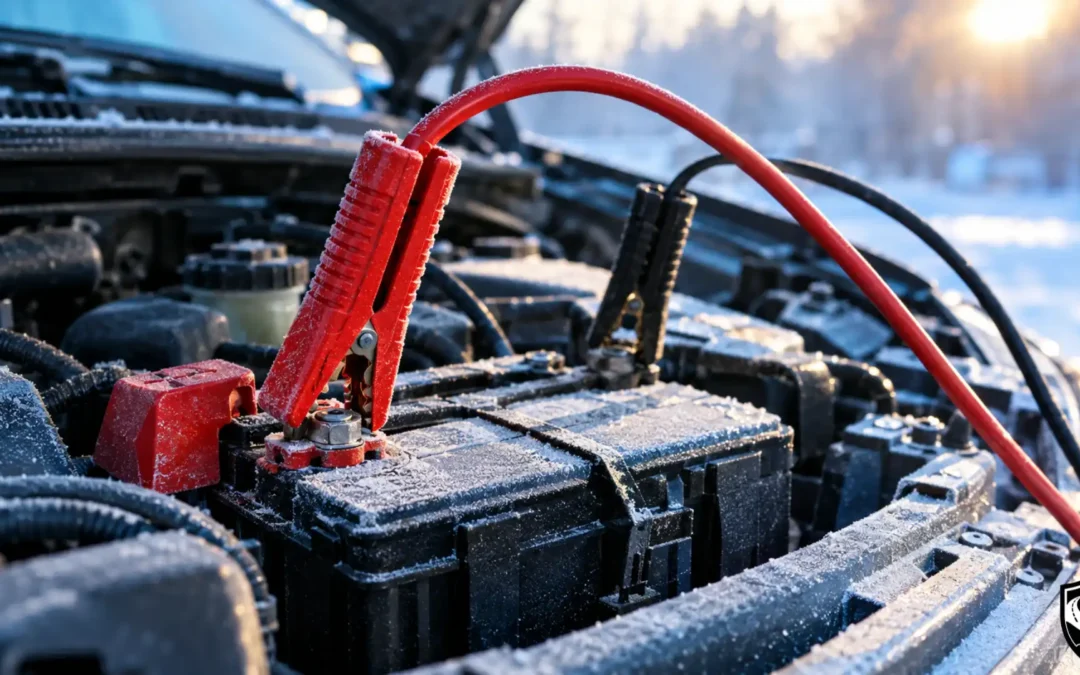
Cars often fail to start on cold mornings because freezing temperatures drastically reduce battery power and thicken engine oil, forcing the battery to work much harder to turn the engine over.
To safely troubleshoot and resolve a cold-weather no-start:
- Check for freezing first: Never jump-start a battery with a bulging case, cracks, or visible ice. Frozen batteries can explode if charged; thaw them completely first.
- Decode the clicks: Rapid clicking indicates low power, while a single click followed by silence means severely depleted voltage.
- Warm up before cranking: When jump-starting, let the donor car run for several minutes to warm the dead battery internally before trying to start the engine. Do not crank immediately.
- Keep jump packs warm: Portable lithium jump-starters lose significant power in the cold. Store them indoors or warm them inside your coat for 15 minutes before use.
- Check EV 12V batteries: Electric vehicles rely on a standard 12V battery to boot up the computers. If this dies in the cold, the EV will not start even if the high-voltage main battery is completely full.
- Prevent future drain: Combat winter battery death by taking weekly 20–30 minute highway drives to fully recharge the system, cleaning terminal corrosion, and upgrading to an AGM battery with at least 600 Cold Cranking Amps (CCA) for harsh climates.
You are running late, shivering in the driver's seat, and desperate for the heater to kick on. You turn the key, expecting the engine to roar, but get a rapid click-click-click or total silence.
You aren't alone. Freezing temperatures drain your battery's power while turning engine oil into thick syrup, leaving your car with less energy right when it needs it most. In 2024 alone, AAA responded to over 5.7 million winter battery calls for this exact reason. You turn the key, or hit the start button, and instead of your engine roaring to life, you hear a sad "click-click-click." Or worse, nothing at all.
Step 1: Figure Out What Kind of "Dead" You're Dealing With
Before you reach for the jumper cables, listen to what your car is telling you.
- Rapid clicking means there's enough juice to engage the starter, but not enough punch to actually crank the engine.
- One click, then silence means the voltage has dropped too low to keep the electrical relays closed.
Here's a trick most guides skip. A cold battery can read fine on a resting voltage test and still collapse the instant you draw real power from it. That's why a professional load or conductance test is more reliable than a quick multimeter check, especially in freezing weather. Consumer Reports recommends testing your battery before winter sets in for exactly this reason. Consumer Reports' battery-testing lead, Paolo Fu, notes that ignoring this can turn a minor issue into a major one, and suggests visiting a mechanic if you've had starting trouble before.
If you're shopping for a new battery, cold-climate drivers should look at the Cold Cranking Amps (CCA) rating. CCA measures the power a battery can deliver for 30 seconds at zero degrees, and Consumer Reports generally recommends cold-weather drivers choose a battery rated at 600 CCA or higher.
Step 2: Check for Explosion Risk First
This part matters: never jump-start or charge a battery that's frozen.
Stop and don't jump it if you notice:
- A swollen or bulging case
- Ice visible inside the vent caps
- Cracks in the plastic casing
- A rotten-egg smell
AAA's official battery-care guidance is blunt about this. In low temperatures, a bulging case or ice inside the cells is a sign the battery has frozen, and a frozen or electrolyte-depleted battery should never be charged or jump-started because it may rupture or explode. As a battery discharges, its electrolyte becomes more like plain water, which freezes solid around 32°F (0°C), that's what creates the danger.
What to do instead: Remove the battery and let it thaw completely in a warm space before testing or charging it.
Step 3: How to Jump-Start It Safely in the Cold
Consumer Reports' jump-start guide walks through the standard sequence:
- Red clamp to the dead battery's positive post
- Red clamp to the donor battery's positive post
- Black clamp to the donor battery's negative post
- Black clamp to an unpainted metal part of the dead car's engine, away from the battery itself
Cars have gotten more electronically complex, so it's worth taking this seriously. AAA's senior repair manager David Bennett warns that skipping proper steps when jump-starting can easily damage the vehicle, and that jump-starting a damaged or frozen battery specifically can cause serious harm to both the car and anyone standing nearby. Consumer Reports' Paolo Fu adds that not following the correct procedure can fry a sensitive electronic component, on top of the usual risks of sparks and battery acid.
The part everyone skips: Don't try to start the car right away. Let the donor car run for several minutes first. A cold, deeply drained battery can't accept a fast charge. This warm-up period lets it warm internally so it's actually ready to take one.
When you do crank it, try short bursts, wait between attempts, and stop after a few tries. Cranking too long risks overheating the starter. If the engine still won't turn over, follow standard car breakdown safety protocols and call for roadside assistance. Always keep your face and hands clear of the battery while connecting cables, in case of a spark.
Step 4: Using a Portable Jump Pack? Keep It Warm
Along with keeping a portable power bank inside your coat, make sure your trunk is stocked with a complete car emergency kit for daily commuters that includes heavy-duty jumper cables, a flash light, and thermal blankets. Leaving one in a freezing car overnight can leave it noticeably weaker when you need it. Keep it inside your house, or warm it in your coat for 15 minutes before use. To connect one, red to positive, black to a metal ground point, turn it on, wait about 30 seconds, then crank.
Step 5: Yes, Even Electric Cars Can "Not Start"
Here's a surprising one. EVs and hybrids can absolutely leave you stranded, even with a full main battery.
Every EV runs on a small 12-volt battery to power its computers and controls before the high-voltage system ever engages. As Midtronics, a company that makes battery-testing equipment for the auto industry, explains: EVs drive on high voltage but "wake up" on 12 volts, since the 12V battery powers the vehicle's brains, closes the main relays, and lets it communicate with a charger. If that battery is weak, the car can seem completely dead, refuse to charge, or throw confusing faults, even though the high-voltage pack is fine.
This isn't a rare fluke, either. It's common enough that automakers issue service bulletins about it. General Motors, for instance, has documented cases of the Chevrolet Volt failing to crank or start purely because of a discharged 12V battery, filed with NHTSA as a technical service bulletin.
Good news: you can jump the 12V system just like a normal car. Bad news: never use an EV to jump-start a gas or diesel car. The power surge can damage the cablesEV's internal electronics.cables
Step 6: How to Stop This From Happening Again
Most winter battery deaths aren't sudden. They build up over weeks of short trips where the heater, defroster, and seat warmers draw more power than a brief drive lets the alternator replace.
A few things that actually help:
- Take a weekly highway drive: A sustained 20–30 minutes at speed lets the alternator properly recharge the battery. Idling in the driveway doesn't do the same job.
- Consider an AGM battery when it's time to replace yours : Consumer Reports notes that higher cold-cranking-amp ratings are typically found in batteries marketed for northern climates and in pricier absorbed glass mat (AGM) batteries, and you can upgrade a car to an AGM battery, though not the other way around if it came with one.
- Clean the terminals: White or green crust around the posts creates resistance. A baking soda and water scrub, then a bit of dielectric grease, keeps current flowing properly.
- Get it tested annually once it's a couple years old: waiting until it fails is the expensive way to find out.
Quick Pre-Winter Checklist
- Get a proper load or conductance test done (aim for 600+ CCA in cold climates)
- Check the case for cracks or swelling
- Clean off any terminal corrosion
- Store jump packs somewhere warm, not the trunk
- Keep quality, heavy-gauge jumper cables in the car
Recent Comments